Conversational AI has moved from buzzword to business essential, raising the question of why conversational AI is now critical for modern organizations. Customers expect instant, personalized answers, while teams are stretched thin. Leaders need scalable solutions to grow without endlessly adding headcount, and AI contact center tools provide exactly that. According to the Talk Business guide to AI in contact centers, when designed well, conversational AI goes beyond answering FAQs—it becomes a smart digital teammate that supports customers, empowers employees, and uncovers insights that were previously invisible. The result: faster service, happier customers, more productive teams, and a healthier bottom line.
To handle complex operations efficiently, companies are adopting cloud computing for AI to process data quickly and reliably. Leveraging AI supercomputing resources helps businesses run advanced analytics and improve customer interactions at scale.
Marketing teams can benefit from AI-driven customer marketing that personalizes messaging and enhances engagement. Similarly, Marketing Runners insights show how AI can streamline campaigns and improve results without extra manual work.
In financial services, AI tools for client support help teams respond faster, detect irregularities, and provide timely guidance. These applications show clearly why conversational AI is not just a tool—it’s a strategic advantage for any modern business.
ImplementingAI-enabled contact center technologies leads to measurable improvements: faster response times, better customer experiences, and actionable insights that empower teams to make smarter decisions. Over time, these solutions drive stronger customer relationships, higher efficiency, and business growth.
Top Contact Center Solutions and Why Conversational AI Matters
When companies ask why conversational AI is critical, the answer lies in its ability to transform customer interactions while reducing operational complexity. AI-driven contact center solutions help businesses respond faster, deliver personalized service, and empower agents to focus on high-value tasks. Here’s a list of top providers leading the way in AI-powered contact centers:
1. Bright Pattern – AI Contact Center Solutions
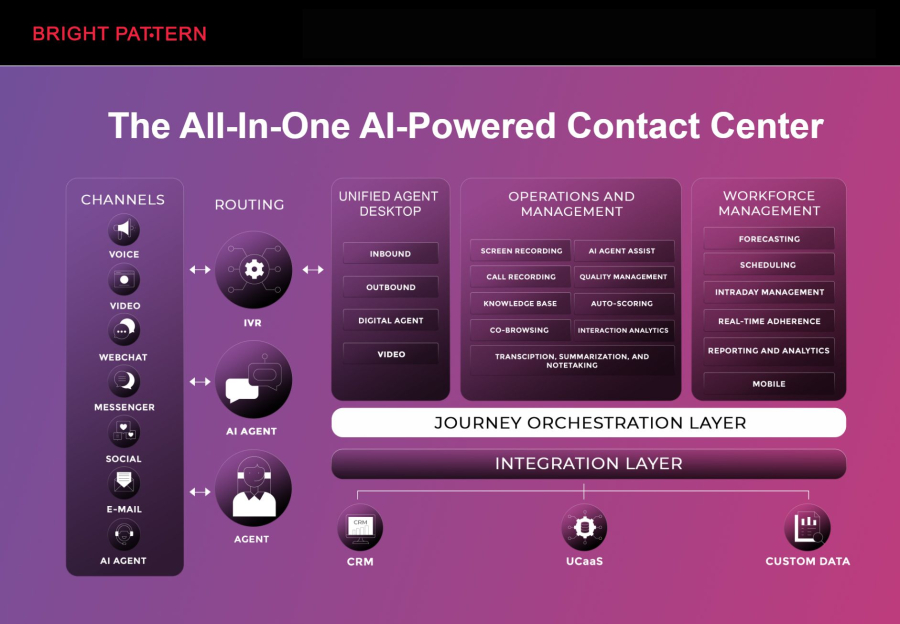
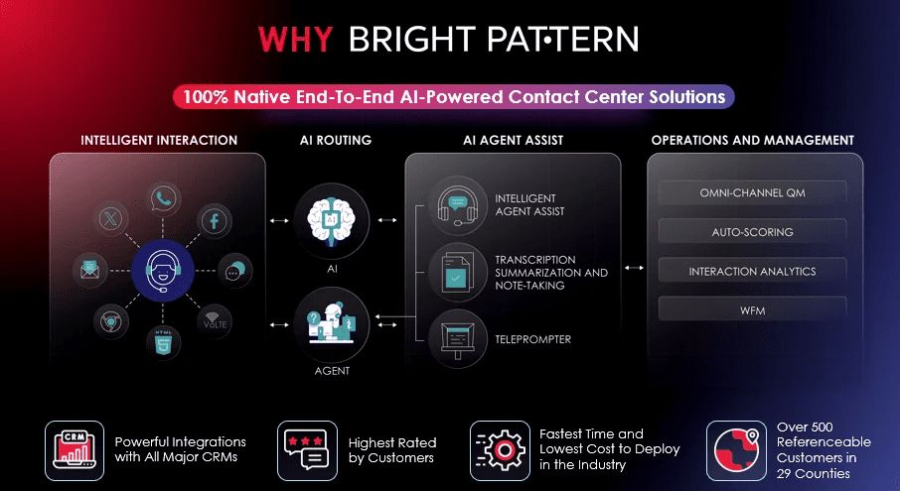
Bright Pattern stands out as a leading provider of AI-enabled contact center solutions. Its platform offers a fully integrated, cloud-based approach that combines conversational AI, omnichannel support, and advanced automation. This allows businesses to streamline operations, reduce wait times, and provide personalized customer experiences.
Key features of Bright Pattern include:
- Omnichannel communication across voice, chat, email, SMS, and social media
- AI-powered virtual assistants for instant responses
- Intelligent routing to connect customers with the right agent
- Advanced analytics to track performance and customer satisfaction
- Easy integration with CRM and other business systems
Bright Pattern’s solutions are designed for scalability, enabling organizations to grow without adding headcount while maintaining high service quality. Their conversational AI capabilities make it easier to deliver consistent, context-aware support across multiple channels.
2. Genesys – Cloud Contact Center Platform
Genesys provides cloud contact center solutions that integrate AI for predictive routing, virtual agents, and workforce optimization. Their platform helps businesses improve response times and deliver proactive support.
3. Five9 – Intelligent Cloud Contact Center
Five9 offers AI-powered call center software designed to enhance agent productivity and customer engagement. Features include omnichannel routing, predictive dialing, and AI-driven analytics.
4. NICE inContact – AI Contact Center Software
NICE inContact combines automation, AI, and cloud infrastructure to optimize call center performance. Their AI tools assist with real-time coaching, chatbots, and sentiment analysis.
5. Talkdesk – Customer Experience Cloud
Talkdesk provides a cloud-based AI contact center platform with features like virtual agents, workflow automation, and analytics to improve both customer and agent experiences.
6. RingCentral – AI Contact Center Solutions
RingCentral integrates AI and automation into their contact center platform, offering omnichannel support, smart routing, and performance analytics to enhance efficiency.
7. 8x8 – Cloud Contact Center AI
8x8 delivers AI-enabled contact center services including intelligent call routing, virtual agents, and workforce optimization tools for improved customer service delivery.
8. Amazon Connect – AI-Powered Cloud Contact Center
Amazon Connect allows businesses to implement AI-powered call center solutions with scalable, cloud-based infrastructure, integrated chatbots, and automated workflows.
9. Cisco Contact Center – Enterprise Solutions
Cisco provides contact center software with AI-driven analytics, omnichannel capabilities, and intelligent routing to improve agent efficiency and customer satisfaction.
10. Avaya OneCloud – AI Contact Center Platform
Avaya’s platform leverages AI for virtual assistants, speech analytics, and workflow automation to deliver faster, more personalized customer service
What Is Conversational AI?
Conversational AIrefers to technologies that enable computers to understand, process, and respond to human language in a natural, dialogue-like way. It typically powers:
- Virtual assistants on websites and mobile apps
- Chatbots in messaging channels such as live chat, SMS, and social platforms
- Voice assistants on phones, smart speakers, and IVR systems
Behind the scenes, conversational AI combines several capabilities:
- Natural language understanding (NLU)to interpret a user’s intent and extract key details.
- Dialogue managementto decide what to ask or answer next.
- Natural language generation (NLG)to craft responses that feel human and helpful.
- Integrationswith your systems, such as CRM, order management, or HR platforms, so it can take action, not just provide information.
Put simply, conversational AI lets people interact with technology the way they naturally speak or type, instead of forcing them to navigate menus, forms, and complex interfaces.
Why Conversational AI Matters Right Now
Several powerful trends are making conversational AI especially valuable today:
- Customer expectations have changed.People are used to instant answers. They do not want to wait on hold or dig through long help articles.
- Support volumes are rising.As digital channels grow, so do inquiries, stretching human teams and driving up costs.
- Talent is scarce and expensive.Hiring and training large support or sales teams is slow and costly.
- Data is underused.Many organizations have valuable data scattered across tools, but lack a simple way for customers and employees to tap into it.
Conversational AI directly addresses all of these pressures: it is always on, highly scalable, and able to surface the right information in seconds, wherever people happen to be.
Core Business Benefits of Conversational AI
When implemented strategically, conversational AI delivers a wide range of benefits across the business.
1. Always-On, Instant Customer Support
- 24/7 availability.Customers can get help any time, across time zones and holidays, without waiting for an agent.
- Instant response times.Chatbots and virtual agents respond in seconds, dramatically reducing perceived wait times.
- Consistent answers.Policies and product information are applied consistently, reducing confusion and escalations.
This always-on support experience boosts customer satisfaction and reduces frustration, even before a human ever joins the conversation.
2. Lower Service Costs Without Sacrificing Quality
- Automation of repetitive tasks.Common questions such as order tracking, password resets, and basic troubleshooting can be handled fully by AI.
- Deflection of routine tickets.A significant share of tickets never reaches a human, reducing workload and operating costs.
- Smarter routing.When human support is needed, the AI gathers details and routes the issue to the right person, saving time on both sides.
Instead of replacing people, conversational AI absorbs the repetitive workload, allowing human experts to focus on complex, high-value interactions where empathy and judgment matter most.
3. Scalable, Personalized Experiences
- Individual context at scale.Connected to your CRM and customer data, AI can recognize returning users, recall past interactions, and tailor its responses.
- Dynamic recommendations.It can recommend products, content, or next steps based on each person’s history and preferences.
- Localized and multilingual support.Conversational AI can communicate in multiple languages, unlocking new markets without requiring full local teams.
The result is an experience that feels personal, even when you are serving thousands or millions of people simultaneously.
4. Higher Conversion and Revenue
- Proactive engagement.AI can start conversations with visitors who appear stuck, reducing abandonment and encouraging action.
- Guided sales journeys.Virtual assistants can help shoppers find the right product, compare options, or calculate pricing in real time.
- Lead qualification.Conversational flows can collect contact info, ask qualifying questions, and route hot leads directly to sales.
By being present at key moments in the customer journey, conversational AI nudges more visitors toward purchase and ensures promising leads reach your human team quickly.
5. Rich Insights From Every Conversation
- Automatic data capture.Every interaction is structured and searchable, making it easier to spot patterns.
- Voice of customer at scale.Frequently asked questions and recurring pain points become visible, guiding product and policy improvements.
- Performance analytics.You can see which flows perform well, where people drop off, and which topics cause confusion.
These insights turn support conversations into a strategic data asset, fueling continuous improvement across the organization.
6. Omnichannel Consistency
- Same knowledge, many channels.One conversational AI engine can power your website chat, messaging apps, mobile app, and even voice channels.
- Fewer silos.Customers get consistent answers, whether they type, tap, or speak.
- Smoother handoffs.When someone moves from self-service to a human agent, the conversation history comes with them.
Omnichannel conversational AI meets people where they are, without forcing them to repeat themselves or start over.
7. Better Employee Experience and Productivity
- Internal virtual assistants.Employees can ask AI for policies, procedures, or system how-tos, instead of searching through documents.
- Faster onboarding.New hires get on-demand answers and guided workflows that shorten ramp-up time.
- Reduced burnout.Taking repetitive tasks off people’s plates lets them focus on meaningful, engaging work.
Happier, more effective employees ultimately translate into better experiences for customers and partners.
Key Benefits at a Glance
|
Benefit |
Primary Impact |
|
24/7 automated support |
Higher customer satisfaction and lower wait times |
|
Automation of routine queries |
Reduced support costs and agent workload |
|
Personalized interactions |
Improved engagement, loyalty, and conversion |
|
Sales and lead assistance |
More qualified leads and higher revenue |
|
Actionable insights from conversations |
Smarter decisions across products and operations |
|
Internal support for employees |
Faster answers and higher productivity |
How Different Teams Win With Conversational AI
Conversational AI does not just belong to customer service. It creates value across multiple functions.
Customer Service and Support
- Resolve common issues automatically while maintaining a friendly tone.
- Give agents instant access to suggested responses, knowledge articles, and relevant customer information.
- Handle spikes in volume without dramatically increasing staffing.
Sales and Marketing
- Engage website visitors in real time and offer tailored product suggestions.
- Qualify leads by asking discovery questions and capturing key details.
- Nurture prospects with interactive content and follow-up conversations.
Human Resources
- Answer common HR and benefits questions for employees, around the clock.
- Guide candidates through job applications and interview scheduling.
- Support onboarding with checklists, policy explanations, and training reminders.
IT and Internal Helpdesk
- Handle routine IT requests like password resets or access requests.
- Provide step-by-step troubleshooting for common technical issues.
- Free IT specialists to focus on strategic projects instead of repetitive tickets.
Real-World Use Cases for Conversational AI
Organizations in many industries are already seeing tangible gains from conversational AI. Typical examples include:
- Ecommerce and retail.Helping visitors find products, checking order status, processing returns, and recommending complementary items.
- Banking and financial services.Answering questions about account balances, transactions, and product options, while escalating sensitive issues to human advisors.
- Healthcare providers.Assisting with appointment scheduling, pre-visit questionnaires, and answers to common non-emergency questions.
- Travel and hospitality.Managing booking details, itinerary changes, and frequently asked questions about policies or amenities.
- B2B software and services.Providing instant technical guidance, onboarding walkthroughs, and account information for users.
In each scenario, conversational AI shortens the distance between a question and a useful answer, while keeping human experts available for situations where they add the most value.
Getting Started With Conversational AI
Implementing conversational AI does not have to be overwhelming. A phased, focused approach works best.
1. Define Clear Objectives
Before choosing tools, clarify what success looks like. Common goals include:
- Reducing average response times for customer inquiries.
- Deflecting a percentage of routine tickets from human agents.
- Improving conversion rates on key pages.
- Providing self-service options for employees.
2. Start With High-Impact Use Cases
Identify the questions or tasks that are:
- Highly frequent,
- Relatively simple, and
- Frustrating or time-consuming for customers or staff.
Examples include order tracking, appointment scheduling, basic policy questions, or simple troubleshooting steps. Automating these quickly delivers visible value.
3. Integrate With Existing Systems
To move beyond basic Q&A, connect conversational AI with core systems such as CRM, order management, ticketing, or HR platforms. This allows it to:
- Look up personalized information.
- Create or update records.
- Trigger workflows and notifications.
Integrated AI does not just answer questions; it completes tasks.
4. Design Human-Centered Conversations
Effective conversational AI feels clear and supportive, not robotic or confusing. Key practices include:
- Using plain language and short messages.
- Providing quick reply options to guide users when appropriate.
- Confirming understanding and summarizing key information.
- Offering a clear path to a human agent whenever needed.
5. Launch, Measure, and Improve
After launch, track performance and refine continuously. Look for:
- Topics with high failure or escalation rates.
- Conversation steps where users drop off.
- New questions that appear frequently.
Use these findings to improve the AI’s understanding, expand its knowledge, and streamline conversation flows over time.
Measuring Success and ROI
To understand the value of conversational AI, define metrics up front and monitor them consistently. Common measures include:
- Containment rate.The percentage of interactions fully handled by AI without human intervention.
- Average handling time.How quickly issues are resolved compared with traditional channels.
- Customer satisfaction scores.Feedback collected after AI-powered interactions.
- Ticket volume per agent.Changes in workload for human teams.
- Conversion and revenue impact.Changes in sales, lead volume, or order value connected to AI interactions.
Many organizations find that even modest improvements, such as automating a portion of common inquiries, deliver a strong return on investment, while setting the foundation for more advanced use cases.
Addressing Common Concerns
Adopting conversational AI naturally raises questions. With the right approach, you can turn these concerns into strengths.
“Will AI Replace Our Human Team?”
In practice, successful deployments show that conversational AIsupportspeople rather than replaces them:
- It handles simple, repetitive interactions that are difficult for humans to enjoy or scale.
- It frees experts to focus on complex, relationship-driven work.
- It can recommend responses or provide context to agents, improving quality and consistency.
Teams often report higher job satisfaction because they spend more time on meaningful tasks and less time repeating the same answers all day.
“What About Accuracy and Quality?”
Quality improves when conversational AI is:
- Trained on up-to-date, authoritative knowledge sources.
- Carefully tested before and after launch with real-world scenarios.
- Continuously monitored, with a feedback loop to correct errors.
Because AI can be centrally updated, you can fix a mistake once and improve every future conversation instantly.
“How Do We Handle Privacy and Security?”
Responsible conversational AI design includes:
- Limiting the collection of sensitive information to what is truly necessary.
- Applying authentication where appropriate before sharing private data.
- Following relevant data protection and retention policies.
With these safeguards in place, conversational AI can safely operate in even highly regulated environments.
The Future of Conversational AI
Conversational AI is evolving quickly, bringing even more opportunities for businesses that adopt it early and thoughtfully.
- More natural, human-like dialogue.Advances in language models are making AI interactions smoother and more context-aware.
- Deeper personalization.Systems will increasingly adapt not only to customer data, but also to individual communication styles and preferences.
- Tighter integration with workflows.AI will move from answering questions to orchestrating complex processes across tools and teams.
- Unified experiences across voice and text.People will be able to start a conversation in one channel and continue it seamlessly in another.
Organizations that build a solid conversational AI foundation today position themselves to take advantage of these innovations, rather than scrambling to catch up later.
Why Now Is the Right Time to Act
Conversational AI is no longer a speculative experiment. It is a proven, practical way to create better experiences for customers and employees while controlling costs and unlocking growth.
By starting with clear goals, focusing on high-impact use cases, and designing human-centered conversations, you can introduce AI that feels natural, trustworthy, and genuinely helpful. Over time, it becomes a core capability that supports every stage of your customer and employee journeys.
The question is no longerwhetherto adopt conversational AI, buthow quickly you can harness itto serve people better and differentiate your business.
